


Take back control of bookings, revenue, and the guest relationship, starting with knowing your audience, choosing the right channels (and budget), and measuring what's working.
If you run an independent property, you already know this: when you sell a $100 room through Booking or Expedia, you don’t keep $100: a chunk of it goes to the platform as commission. It happens to most hotels, every day, and it’s one of the heaviest (and least talked about) costs of running an independent hotel.
The good news is you can win back a large part of that margin: every booking that comes directly through your own site, instead of Booking or Expedia, pays no commission at all and the revenue stays with you. And building a strategy that drives more direct bookings doesn’t take a huge budget or a marketing department: it takes a website that converts, the right channels, and a contact list that’s entirely yours.
To be fair, OTAs (booking platforms like Booking.com, Expedia, or Airbnb) are still a useful ally: they help you get discovered and fill rooms during low-demand periods.
The problem starts when they become your only channel. At that point you lose control of the guest relationship: you often don’t even have their email, so you can’t reach out again when they’re ready to book their next stay.
In this guide you’ll find:
- how to build an effective strategy starting from who your ideal guest is;
- how much budget you actually need;
- which channels to activate and which practices to put in place;
- how to tell if your strategy is working, and which mistakes to avoid.
All of it backed by data updated for 2026, so you understand what’s really changing in the way people choose a hotel.
Let’s get started.
Prefer to watch instead?
We covered hotel digital marketing on our YouTube channel. You’ll find the video below 👇

TABLE OF CONTENTS
- What is independent hotel marketing (and why "generic" marketing doesn't work)
- How to Build Your Hotel Marketing Plan: 3 Questions to Ask First
- How much should you spend on hotel digital marketing?
- 8 actions to put into your independent hotel marketing strategy
- Independent hotel marketing: OTAs and your own strategy work together, not against each other
- Frequently asked questions about independent hotel marketing
What is independent hotel marketing (and why "generic" marketing doesn't work)
Here’s the thing upfront: “generic” marketing, the kind that works for selling almost any other product or service, doesn’t apply the same way to a hotel. Here’s why.
Independent hotel marketing is the set of strategies and actions you can use, as the operator of a property, to get known, attract new guests, retain the ones you already have, and increase direct bookings, reducing your dependence on intermediary platforms (OTAs). It includes very different activities that work together across different stages of your guest’s decision journey: from initial inspiration, to comparing properties, to booking, to post-stay loyalty.
The reason generic marketing isn’t enough for a hotel is simple: tourism has four specific traits that generic marketing isn’t built to handle.
The first is seasonality: demand can concentrate into a few months or even a few weekends, and your challenge shifts radically over the year, from selling every available room in almost no time, to waiting weeks for demand to come back.
The second is the huge weight reviews carry in the booking decision: a guest can’t “try” a room before paying for it, so they rely heavily on people who already have.
The third is the presence of intermediaries like OTAs and metasearch engines, which compete directly for the same customer and often show your property side by side with your competitors, on the same screen, at the same moment.
And finally there’s the length of the buying journey, which in most cases stretches over days or weeks, not minutes: the first contact with a potential guest rarely lines up with the booking itself, and that window of time is where most of your strategy actually happens.
Ignoring even one of these four traits is often why a marketing strategy, however carefully built, doesn’t deliver the results an independent hotel needs.
The 2026 data on hotel marketing
Here’s a clear picture of how travelers behave today, before choosing what to put into action.
OTAs dominate, but they come at a cost
- 55% of global bookings go through an OTA (source: Prostay, 2026)
- 15-25% average commission withheld on every booking (source: Mews, 2026)
AI is already part of the decision-making process
- 54% of travelers globally say they trust AI to help plan or book a trip, up from 47% the year before (source: Skyscanner Travel Trends, 2026)
A strategy makes a measurable difference
- 30-50% is the direct booking share considered healthy for an independent property (fonte: Otelciro, 2026)
- Below 20% is already a sign of excessive OTA dependence (fonte: OnlineHotelier, 2026)
Hotels underinvest in their own marketing
- Independent hotels typically spend well under 3% of revenue on marketing, while an OTA like Expedia spends roughly 54% of its revenue on marketing (source: The Brand Amplifiers, 2026)
How to Build Your Hotel Marketing Plan: 3 Questions to Ask First
A hotel marketing strategy that works is built by answering three questions, always in this order, before you even choose which channels to activate:
- who is the guest you want to win over;
- what makes you different in their eyes;
- what you actually want your marketing plan to achieve.
Skipping them (jumping straight into a social post today, a promotion tomorrow, without really knowing who you’re talking to) is the most common way to spend budget without seeing results: even the best-looking website or the most polished campaign, if it speaks to a generic audience, attracts a generic audience… and a generic audience rarely books.
The order isn’t random: you can only know how to stand out once you understand who you’re trying to win over, and you can only know what to actually ask of your marketing once you’ve figured out who you’re targeting and what makes you different. Let’s look at each question on its own.
1. Who is your ideal guest?
Your hotel doesn’t share the same audience as every other property, and treating your guests as a generic target is the first mistake that limits your results.
If you run a mountain hotel, your audience is probably active travelers interested in hiking, mountain biking, or skiing in winter, and the content that works best for you is photos and videos of trails, views, outdoor activities.
If you run a family-friendly beach hotel, the picture changes: you’re targeting people traveling with kids, maybe offering a kids’ club, evening entertainment, and children’s menus. Moreover, what matters most to your guests are practical reassurances like safety, space, and family-friendly services.
If you run a B&B in an art city, your target is more often a couple visiting for a weekend, interested in culture, dining, and niche experiences. The content that works tells the story of the neighborhood, the itineraries, the small details that make a short stay memorable.
If instead you run a business hotel in a city, your target is business travelers looking above all for efficiency: reliable wifi, meeting rooms, proximity to stations or business districts, flexible check-in.
Defining this profile precisely changes everything: the tone of your content, which channels to use, which keywords to target in SEO, even the best times to post on social media.
#BBD0E0 » 5 the editor Impostazioni relative alla privacy e ai cookie Piattaforma gestita da Google. Conforme al TCF di IAB. ID CMP: 3002. What makes you different from competitors in your area?
Do a little market research on the hotels competing with you locally: look at their websites, their social pages, the reviews they get, both positive and negative (negative reviews often reveal an opportunity).
Ask yourself: what can I offer that they don’t? What will my guests find with me that they won’t find elsewhere? It could be something tangible (a rooftop pool, a restaurant with local ingredients, the location) or something less tangible, like the type of hospitality or the story of the property.
This distinctive element (your positioning) is what should show up consistently in every piece of content: on your website, on social media, in your emails, and in the reviews you ask your guests to leave.
3. What's the real goal of your marketing plan?
This is where it’s easy to get the approach wrong, and many hoteliers do. The business goal (filling rooms) is correct, but it doesn’t automatically match your marketing goal. An online booking, in fact, is rarely a guest’s first step: it’s the result of a series of earlier actions, often spread across days or weeks.
Your job is to show up in the “right digital places” at each of these stages, not just on Booking and Airbnb, which almost always only catch the final stage, the moment the guest is already ready to convert.
The most common mistake is putting all your effort (website, content, ad budget) into that final stage only, leaving unanswered all the time a guest spends comparing alternatives. If you have no way to stay in touch during that window, you lose them the moment they close the browser tab.
That’s where one of the most effective things you can do comes in: getting people to sign up for a newsletter. An email list lets you accompany that waiting period with information, offers, and content that build trust, what’s called nurturing in marketing: taking care of the relationship over time, well before the conversion happens.
How much should you spend on hotel digital marketing?
There’s an underlying problem that affects almost every hotel: you’re likely investing too little in your own marketing compared to what OTAs invest in driving traffic on your behalf.
In the US, for example, independent hotels invest under 3% of revenue in marketing on average, while an OTA like Expedia invests around 54% (source: The Brand Amplifiers, 2026). That imbalance in investment is a big part of why OTAs dominate visibility in generic searches.
So how much should you actually spend?
There’s no one-size-fits-all number, but a useful approach is to think in terms of priority rather than isolated channels. If your website isn’t converting (maybe the sign-up form isn’t visible, the booking engine is confusing, or the page loads slowly) that’s where you invest first, because every other channel will just send traffic to a door that won’t open.
The second priority is almost always building your contact list, since it costs little and delivers a strong return. And unlike a paid ad campaign, which stops the moment you stop paying, a contact list keeps generating value long after you’ve built it.
Only after your website and contact list are working properly does it make sense to spend ad budget on metasearch (price comparison engines), social, or Google Ads — doing it earlier risks generating traffic that scatters without leaving anything behind.
8 actions to put into your independent hotel marketing strategy
Now for the practical part: what to actually do to get discovered, convert, and retain your guests.
A word of warning first: what follows isn’t a checklist to tick off all at once, nor a set of disconnected initiatives: they work well only as a team. Here’s what that means in practice.
A website that converts but has no traffic reaching it doesn’t help much, and driving traffic to a website that doesn’t convert is a way to waste ad budget. That’s why these 8 actions come in a specific order: you start with the website, because that’s where the traffic generated by every other activity needs to arrive (and convert), and then move toward the channels that actually generate that traffic.
You don’t need to activate all eight right away, especially on a limited budget: pick the ones most relevant to your audience and to where your property stands today, and build from there.
1. A website optimized for conversion
Your official website is the foundation of every strategy: it needs to be well designed, fast to load (over half of travel searches happen on mobile), and built to convert — not just to “look nice.”
In practice that means having a newsletter sign-up form that’s always visible (not buried at the bottom of the page or inside a secondary menu) and a clear booking engine, with few steps between choosing a room and confirming.
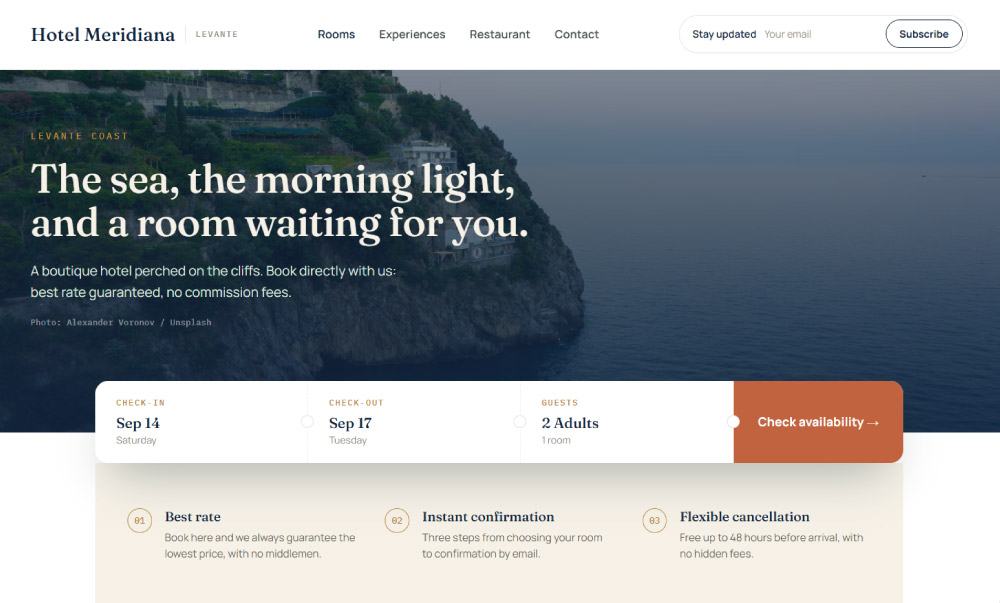
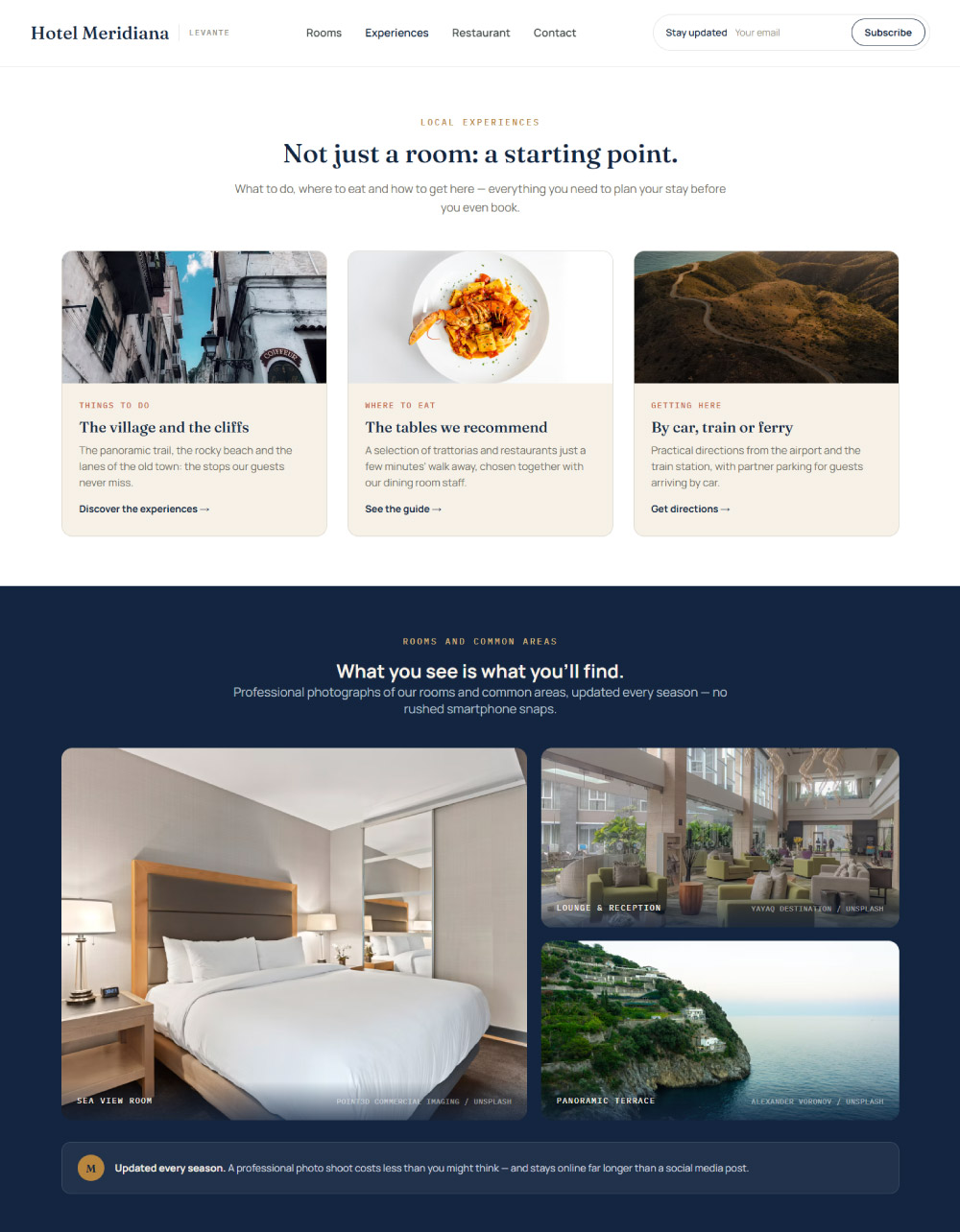
You also need dedicated pages for local experiences (things to do, where to eat, how to get there): useful both for SEO and for reassuring guests who are still deciding, and professional photos of your rooms and common areas: photos shot quickly on a phone are often the number one reason a visitor leaves the page.
2. Local SEO (and optimizing for AI search)
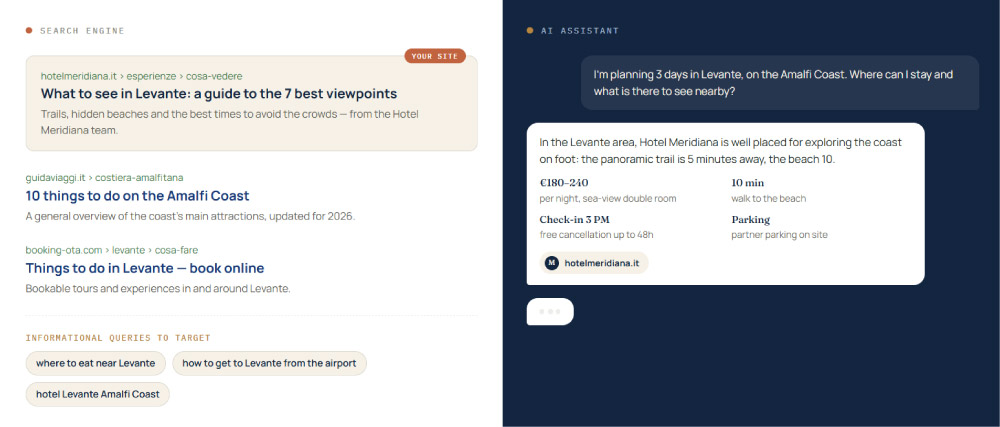
Optimize your website’s content for keywords like “hotel + your destination,” but don’t stop there: also target informational queries about the area (“things to do in…”, “where to eat near…”, “how to get to… from the airport”). These are searches from people still planning their trip, so they’re more likely to sign up for your newsletter than to book right away.
The highest-value booking keywords are often dominated by OTAs and metasearch engines, which have the budget and domain authority that’s hard for a single property to match. Owning the informational searches about your destination is where you have the most room to rank.
There’s also a more recent front to consider: with a growing share of travelers using generative AI tools to plan trips, writing clear, well-structured content with verifiable information (hours, services, distances, indicative prices) increases the odds that your hotel gets picked up in AI-generated answers too, not just in classic search results.
3. Metasearch and Google Hotel Ads
Price comparison engines, known as “metasearch,” the best known being Google Hotel Ads, Trivago, Kayak, and TripAdvisor, show your direct rate right next to OTA rates, in the same search result: whoever clicks on your rate lands directly on your site, not on Booking or Expedia. It’s one of the few tools that lets you compete with OTAs at the exact moment a traveler is comparing prices, usually paying only per click or only when a booking goes through, in either case typically less than what you’d pay in OTA commission. To activate it you need a booking engine on your site compatible with these services, and ideally an up-to-date Google Business Profile connected to it.
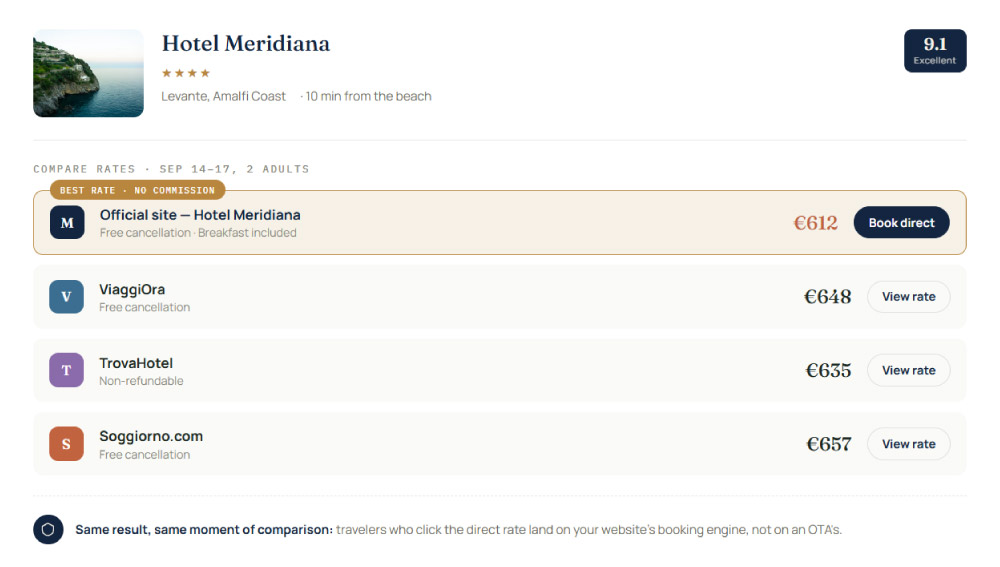
Google Hotel Ads deserves a closer look because it’s built directly into the Google ecosystem: your rate can appear in Google Search, Google Maps, and Google Travel, all places travelers already spend a lot of time. One important detail: your ad’s position depends mostly on how much you’re willing to bid, not on whether you offer the lowest price. A competitive rate helps conversion once someone clicks, but it isn’t what determines whether your ad shows near the top or further down.
4. Social channels with a consistent content plan
Open the right social profiles for your audience (you don’t need to be everywhere, two well-run channels beat five abandoned ones) and publish content consistent with your positioning. If you run an outdoor-focused mountain hotel, lean into photos and videos of trails, hikes, outdoor activities. If you run a B&B in a historic center, tell the story of the neighborhood, the lesser-known corners, the local traditions.
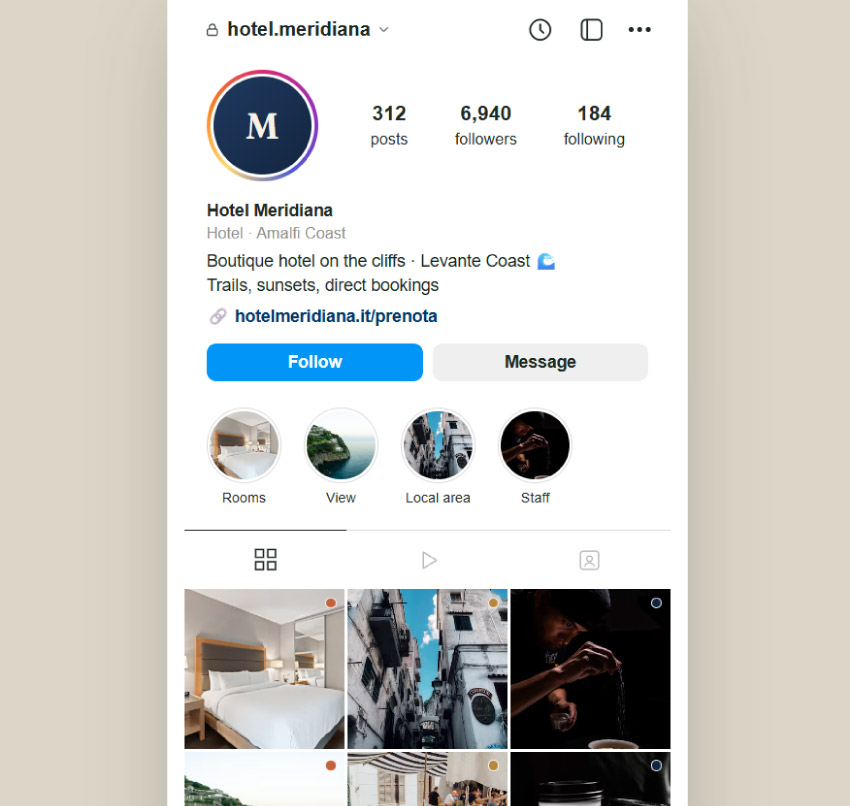
A basic content plan mixes “showcase” content (the property, rooms, amenities), destination content (events, places, seasonality), and “human” content (staff, behind-the-scenes, the property’s story). The last category is often what drives the most engagement.
5. Collaborations with influencers and local creators
Offer free stays or paid partnerships to creators in your target audience: it’s a way to reach new people through a channel that feels more authentic than traditional advertising. You don’t need to chase huge names, micro-influencers with a smaller but highly relevant audience (families, hiking enthusiasts, honeymooners) often deliver a better return than more expensive, generic partnerships. Always define upfront what you want out of the collaboration (content you can reuse, traffic to your site, newsletter sign-ups), not just “visibility.”
6. Partnerships with tourism boards and local businesses
A channel you’re probably underusing: look into partnerships with local tourism boards, business associations, restaurants, or other local businesses to build joint packages or simple visibility exchanges (a link from their website, a listing in local guides, mutual shout-outs on social media).
These organizations often already have the attention of people planning a trip to your area, at a stage when the choice of hotel isn’t set yet: a chance to get on their radar before the decision is made.
7. Actively managing online reviews
After check-out, send an email with a direct link to Google or Trustpilot to leave a review: doing it while the experience is still fresh noticeably increases response rates compared to a generic request sent weeks later.
Reviews carry so much weight in how a hotel gets chosen that they come into play as early as the inspiration stage, not just during the final comparison between properties. Responding professionally to negative reviews, too, is often more effective in the eyes of readers than only having five-star reviews.
8. An email list that supports the entire guest journey
Email is the channel hotels neglect most often in their marketing plans, and it’s also the only one, of everything covered in this guide, that stays entirely in your hands: no algorithm deciding who sees what, no platform that can change the rules overnight.
There’s a step that comes before everything else, though: before you can send any email, you need to build the list. And the easiest way to grow it isn’t asking “want to sign up for our newsletter?”: it’s offering something in return. People hand over their email far more willingly when they get something concrete back: a guide to the area, a small discount on breakfast, early access to seasonal offers.
Once you’ve built your contact list, you can use it in three ways.
The first is welcoming people who discover your hotel for the first time with a welcome series. Not a single email, but a short sequence that opens with a welcome message, moves on to introduce your services and the area, and might close with a small incentive to book.

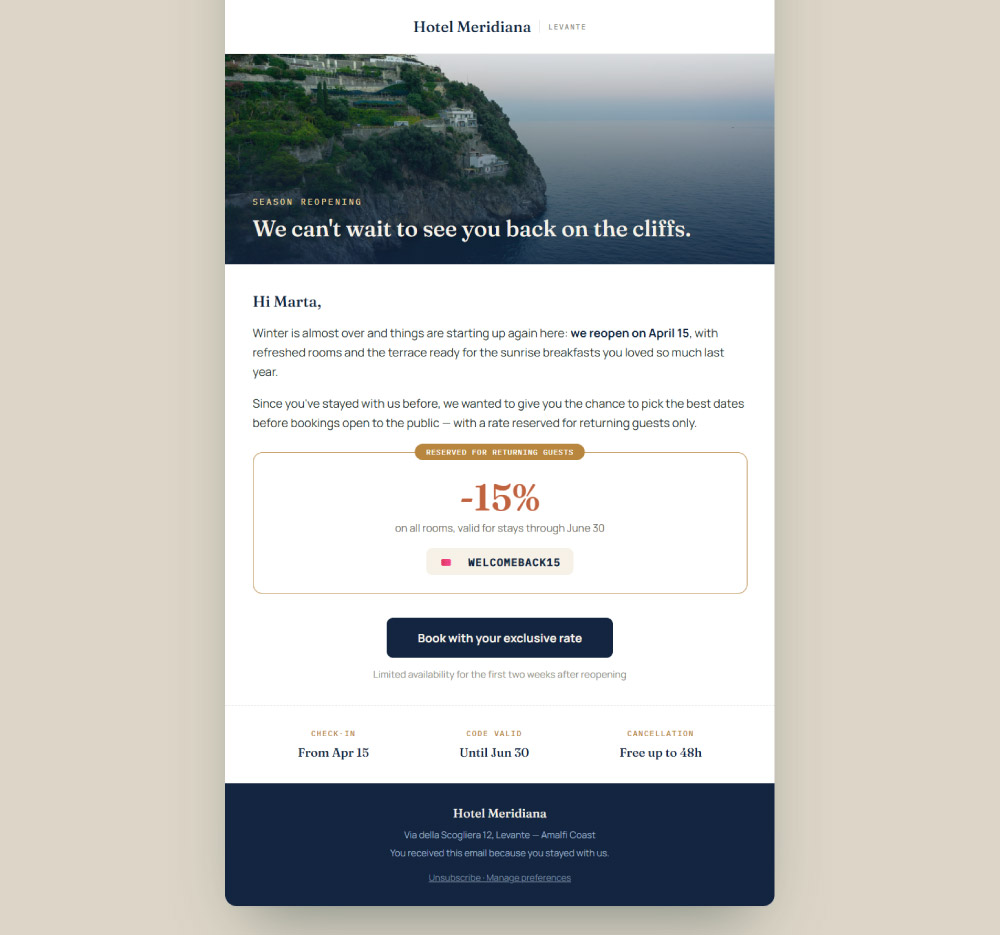
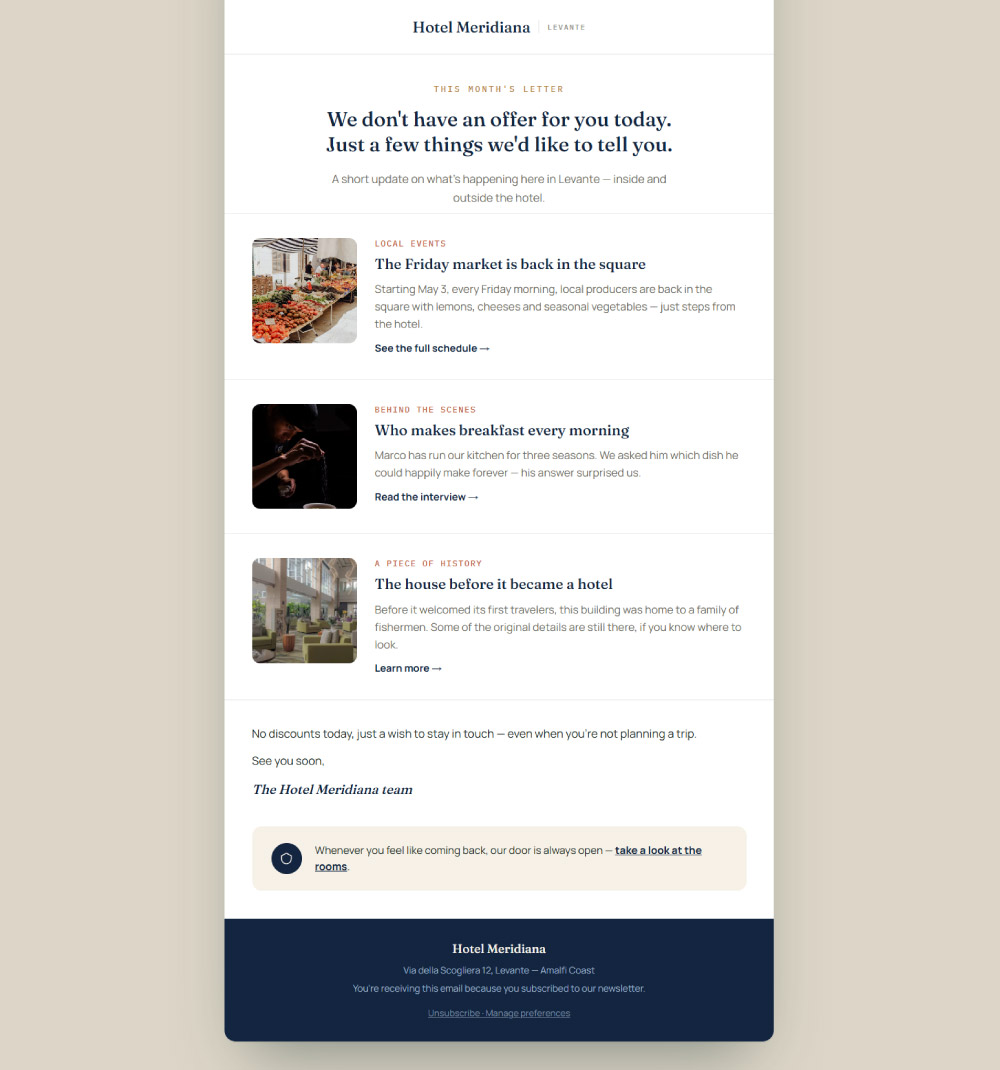
The second is staying in touch with people who’ve already stayed with you, with seasonal offers and dedicated packages sent at the right moment, like a season-reopening announcement, for example, or a discount reserved for returning guests.
Hotel email marketing?
Here's everything you need to know.
What should you actually write in your emails? When should you send them? And how do you design messages that get opened?
We covered it all in a dedicated article 👇
Independent hotel marketing: OTAs and your own strategy work together, not against each other
Building an independent hotel marketing strategy doesn’t mean choosing between OTAs and a website of your own: it means having both, without depending entirely on a single channel.
To be clear, OTAs work well as one of your booking channels, they’re just not meant to be the only one. They’re useful for filling rooms during low-demand periods and for getting discovered by people who don’t know you yet. The problem starts when they become your only channel: at that point every booking pays a fixed commission (15-25%, as we saw earlier), and the guest belongs to the platform, not to you. That means no email, no way to reach out again when they start thinking about their next trip.
The eight actions covered in this guide aren’t asking you to leave OTAs behind. They’re asking you to build, alongside them, a channel you control: a website that converts visitors into bookings, content that brings people to your site before they even look at Booking, and, above all, a contact list: the one asset, among everything covered here, that stays yours no matter what an algorithm or a platform does.
Where to start depends on what’s missing in your property today, not on a fixed rule. If your website is losing people before they get to booking, focus your effort there first. If your website works fine but you have no way to stay in touch with visitors who don’t book right away, building your email list becomes the priority.
Email marketing, in particular, is the one strategy that keeps working for you even when you’re not thinking about it, with the lowest cost and the highest degree of control. You don’t need a big budget or technical skills to start building your contact list and your first automations.
Start your free trial of Emailchef today! No credit card required.
Frequently asked questions about independent hotel marketing
No. They help you get discovered and fill rooms during low-demand periods, but they don’t give you the guest’s contact details or protect you from commissions, which run 15-25% of every booking. A website that converts, SEO content, and an email list let you reach demand before it ever lands on a booking platform.
It’s the set of strategies and actions (website, SEO, social, reviews, email) you use to get known, attract guests, and increase direct bookings while reducing dependence on OTAs. Unlike generic marketing, it accounts for seasonality, the weight of reviews, and a buying journey that stretches over days or weeks.
It shows your direct rate next to OTA rates in the same search result. You pay only per click, or only when a booking goes through, typically less than you’d pay in OTA commission. You need a compatible booking engine and an up-to-date Google Business Profile.
Start with wherever you’re losing the most people today: if your website isn’t converting, that’s the first fix; if the website works but you have no way to stay in touch with visitors, building your email list becomes the priority. Properties that work at this consistently reach a 30-50% direct booking share.
Start with three questions, in this order: who is your ideal guest, what makes you different from local competitors, and what your marketing plan is actually meant to achieve: not just filling rooms, but also building a contact list. Only after that do you choose your channels.