

From building your list to recovering abandoned carts: a complete guide for sellers and e-commerce companies
Although time and technology evolve, email marketing remains one of the most profitable digital marketing strategies, especially for sellers and e-commerce companies.
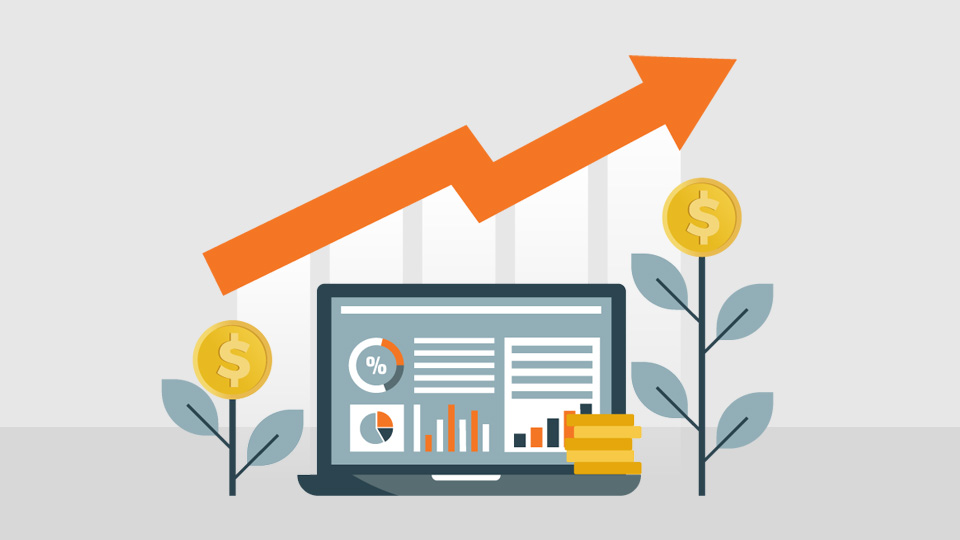
In 2026, email marketing generates an average return of $42 for every $1 invested, the highest ROI of any digital marketing channel. And 4 out of 5 marketers say they would rather give up social media than email marketing.
Email marketing isn’t an alternative to other digital channels like social media or Pay-Per-Click marketing (PPC). It makes them more effective. Because email is the most direct communication channel between a brand and its customers, it amplifies everything else you do.
How do you use email marketing to increase sales?
Build a quality list, send personalized messages at the right time, automate the key touchpoints, and track every result. The 18 strategies below show you exactly how, from collecting your first subscribers to recovering abandoned carts and staying out of the spam folder.
Table of contents
- 1. Give Your Visitors a Strong Reason to Subscribe
- 2. Create Responsive Emails that Perform Well on Mobile Devices
- 3. Re-Engage Inactive Subscribers
- 4. Work Your Subject Lines
- 5. Build a Dedicated Landing Page for Each Email Marketing Campaign
- 6. Give Your Email’s Content the Right Template
- 7. Use GIFs or Animated Content
- 8. Send Exclusive Content
- 9. A/B Test to Find the Most Effective Messaging
- 10. Exploit Social Proof: Collect Reviews and Be Recognised as a Secure Seller
- 11. Leave Your Readers in Suspense
- 12. Create Appealing Welcome Emails
- 13. Use CTAs
- 14. Use the word YOU
- 15. Integrate Email and Social Media
- 16. Use Abandoned Cart Emails
- 17. Stay Out of the Spam Folder
- 18. Don’t Give Up Your Email Marketing Strategies
- Frequently asked questions about email marketing strategies
1. Give Your Visitors a Strong Reason to Subscribe
The value of a website is measured by numbers, and especially the number of subscribers. But collecting those subscribers isn’t easy. People don’t just give their email addresses to anyone. They need a good reason to accept content in their inboxes.
The best approach is to offer something valuable in return, what marketers call a lead magnet. Your offer must be compelling enough to persuade people to fill in the form and share their data. Here are some proven examples:
- a free quiz with the result sent by email;
- a discount or coupon reward for signing up;
- a free ebook, guide, or checklist related to your business;
- a trial lesson or sample chapter for a course;
- early access to new products or exclusive sales;
- a free template or tool your audience can use immediately.
The more relevant your lead magnet is to your target audience, the higher your conversion rate will be. A generic “subscribe to our newsletter” button converts at around 1-2%. A specific, valuable offer can push that above 5%.
Keeping attention on the way you collect contacts is one of the most profitable email marketing strategies for sellers. Don’t neglect it.
2. Create Responsive Emails that Perform Well on Mobile Devices
Creating emails optimised for mobile devices is no longer optional: it’s fundamental for any successful email marketing campaign. In 2026, over 60% of email opens occur on mobile phones and tablets. If your email isn’t displayed correctly on a small screen, it will most likely be deleted within seconds.
Here’s what responsive email design looks like in practice:
- Single-column layout: easier to read on small screens than multi-column designs.
- Large, tappable buttons: CTAs should be at least 44×44 pixels so fingers can tap them easily.
- Short subject lines: mobile screens cut off subject lines after around 40 characters
- Font size of at least 14px: anything smaller is difficult to read without zooming.
- Images that scale: use percentage-based widths so images resize automatically.
- Preview text: the short line that appears next to the subject line in the inbox; use it to reinforce your message.
Most professional email marketing platforms, including Emailchef, have drag & drop editors with mobile-responsive templates built in, so you don’t need to write a single line of code to get this right.
And at any point during the creation process, Emailchef lets you preview exactly how your email will look on desktop, tablet, and mobile: just click the device icons at the top of the drag & drop editor workspace.

3. Re-Engage Inactive Subscribers
Re-engaging inactive subscribers is easier and cheaper than finding new ones, yet most sellers ignore this opportunity. All email lists have inactive subscribers who haven’t opened or clicked in months.
Left unaddressed, they hurt your deliverability: inbox providers like Gmail and Outlook use engagement signals to decide whether your emails reach the inbox or the spam folder.
A subscriber is generally considered inactive after 3-6 months without any engagement. When that happens, don’t give up on them: run a re-engagement campaign first.
Here are the most effective strategies to win them back:
- A “we miss you” email: simple, personal, and surprisingly effective. Remind them why they signed up in the first place.
- An exclusive discount or gift: give them a compelling reason to come back and make a purchase.
- A “last chance” email: let them know you’ll be removing them from your list if they don’t engage. The urgency often works.
- A preference update: ask them if they want to receive fewer emails or different content. Some people disengage because of frequency or relevance, not lack of interest.
If none of these work, remove them from your active list. A smaller, engaged list always outperforms a large, inactive one (both for deliverability and for sales).
The good news is that you can automate the entire re-engagement process. With Emailchef Flow, you can set up a sequence that triggers automatically when a subscriber becomes inactive, all without any manual work.
And if you need inspiration for the emails themselves, Emailchef’s template library includes ready-made re-engagement templates you can customise and send in minutes.
4. Work Your Subject Lines
The subject line is the first thing subscribers see when they receive your email, and it determines whether they open it or ignore it. A well-crafted subject line can dramatically improve your open rate. A poor one gets your email deleted or, worse, reported as spam.
Here are the best practices that actually work:
- Keep it under 40 characters for mobile: longer subject lines get cut off on small screens. Get to the point fast.
- Use numbers: “5 ways to increase your sales this week” consistently outperforms vague subject lines. Numbers signal specificity and set expectations.
- Create curiosity or urgency: “You’re leaving money on the table” or “Last 24 hours: 30% off” give readers a reason to open now rather than later.
- Personalize when possible: adding the recipient’s name or location to the subject line can increase open rates by up to 50%.
- Use emojis carefully: some studies show emojis can increase open rates, but results vary by audience and industry. Test before committing.
- Avoid spam trigger words: phrases like “free”, “percent off”, “act now” and “guaranteed” can send your email straight to the spam folder if overused.
- A/B test your subject lines: never assume. Send two versions to small segments of your list and let the data decide which one wins.
The subject line is worth more time than most sellers give it. Treat it like a headline, because that’s exactly what it is.
Emailchef makes all of this easier with a few built-in tools. When setting up your campaign, a character counter shows you the length of both your subject line and preheader in real time, so you never go over the limit.
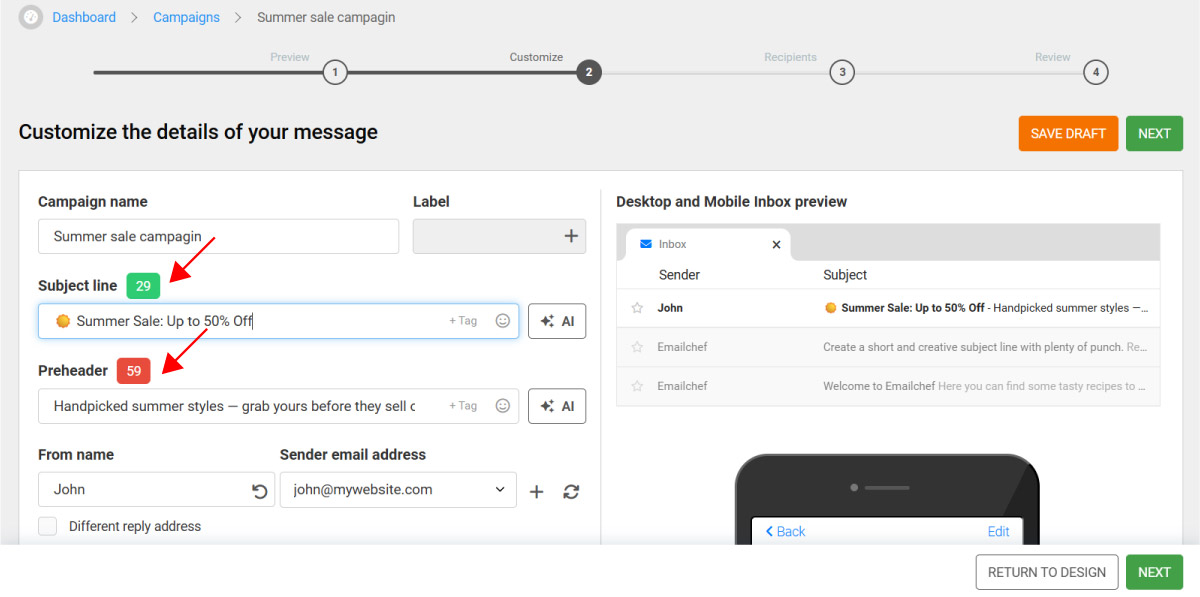
There’s also an integrated AI tool that suggests subject lines and preheader text based on your campaign content, so you always have a starting point even when inspiration runs dry.
And to personalize your subject lines at scale, Emailchef’s placeholder fields automatically insert each subscriber’s name, or any other data you’ve collected, into every email you send, without any manual work.
5. Build a Dedicated Landing Page for Each Email Marketing Campaign
When you send an email that encourages a purchase or offers special content, you direct your subscribers somewhere. That destination matters as much as the email itself.
Sending people to your homepage is one of the most common (and costly) mistakes in email marketing. A homepage is designed for everyone. A landing page is designed for one specific person, with one specific goal.
The numbers back this up: dedicated landing pages convert at significantly higher rates than generic web pages because they remove distractions and keep the visitor focused on a single action.
The perfect landing page for an email campaign should contain:
- A headline that mirrors your email’s promise: if your email says “Get 30% off today”, your landing page should say the same. Any disconnect between the two loses trust instantly.
- A single, strong call-to-action: one goal, one button. Don’t give visitors multiple options.
- Social proof: customer reviews, ratings, or testimonials that reassure visitors they’re making the right decision.
- Compelling images or video: show the product or outcome, not just describe it.
- A clean, distraction-free layout: no navigation menu, no links to other pages. Keep the visitor focused.
- Fast loading speed: every second of delay reduces conversions. Keep it lean.
Think of your landing page as the final step in a conversation you started in the email. It should feel like a seamless continuation: same tone, same offer, same visual style.
6. Give Your Email’s Content the Right Template
When planning your email marketing strategy, don’t underestimate the importance of the right template.
How you arrange the elements of your email is as important as what you write. A poorly structured email (even with great content) loses readers before they reach the CTA.
Here’s what an effective email template looks like:
- One clear visual hierarchy: the reader’s eye should move naturally from the header to the main message to the CTA. Don’t compete for attention with multiple focal points.
- Short paragraphs and plenty of white space: walls of text get skipped. Break your content into digestible chunks with clear subheadings.
- A single primary CTA: just like a landing page, your email should have one main action you want the reader to take. Make it visually prominent.
- Consistent branding: colors, fonts, and logo should match your website and other marketing materials. Consistency builds trust.
- Images that support the message: not just decoration. Every image should reinforce what you’re saying or show what you’re offering.
- A clear footer: include your company name, address, and an easy-to-find unsubscribe link. It’s not just good practice, it’s legally required in most countries.
If you’re not comfortable with HTML, Emailchef’s drag & drop editor lets you build professional, fully responsive email templates without writing a single line of code. Choose from over 1,000 ready-made templates designed for every industry and occasion, or start from scratch and build your own. Every template is optimised for all devices and email clients automatically.
4. Use GIFs or Animated Content
Animated GIFs are one of the easiest ways to make your emails stand out in a crowded inbox. They add movement, personality, and visual interest without requiring video production. Used well, they increase engagement and click-through rates. Used poorly, they slow down your email and distract from your message.
Here’s how to use animated content effectively:
- Use GIFs to demonstrate a product: a short animation showing how something works is far more effective than a static image.
- Create urgency with a countdown timer: animated countdown timers in promotional emails are proven to increase conversions during flash sales or limited-time offers.
- Celebrate moments: Christmas, New Year, Easter, Black Friday, and even subscriber birthdays are all opportunities to surprise your audience with something unexpected and memorable.
- Keep file sizes small: large GIFs slow down email loading times, especially on mobile. Aim for under 1MB wherever possible.
- Always include a strong first frame: some email clients don’t support animation. Make sure the first frame of your GIF works as a static image on its own.
- Don’t overdo it: one animated element per email is usually enough. More than that competes for attention and dilutes your message.
8. Send Exclusive Content
Exclusivity is one of the most powerful psychological triggers in marketing. When subscribers feel they’re getting something nobody else has access to, they pay more attention, engage more, and are more likely to buy. Your email list is a VIP club, treat it that way.
Here are proven ways to make your subscribers feel special:
- Promo codes and discounts for subscribers only: “This offer is exclusively for our email list” is one of the most effective phrases in email marketing.
- Early access to new products or sales: let your subscribers shop before anyone else. It rewards loyalty and drives immediate action.
- Behind-the-scenes content: share what’s happening inside your business: new product development, team stories, upcoming launches. People connect with brands that feel human.
- Tutorials and DIY guides: practical, useful content that helps subscribers get more value from your products builds trust and keeps them engaged between purchases.
- Subscriber-only giveaways: run contests exclusively for your email list. It reinforces the value of being subscribed and generates excitement.
- Insider news before it goes public: let your subscribers be the first to know about new arrivals, partnerships, or announcements. Being first feels special.
The goal is to make unsubscribing feel like a loss. If your subscribers know they’ll miss out on something valuable by leaving, they’ll stay and keep buying.
9. A/B Test to Find the Most Effective Messaging
A/B testing is the most reliable way to improve your email marketing results, because it replaces guesswork with data. Instead of assuming what your subscribers want, you test two versions and let them tell you.
Here’s how it works: design two versions of your email with one element changed, send each version to a different segment of your list, and compare the results. Use a professional platform like Emailchef to run the test and analyse the data automatically.
The elements worth testing, in order of impact:
- Subject line: test for open rate. This is the highest-leverage test you can run.
- CTA: test the wording, color, size, and placement for click-through rate.
- Headline: test for engagement and time spent reading.
- Images: test whether a product photo, lifestyle image, or no image performs better.
- Offers: test a percentage discount vs. a fixed amount (e.g. “20% off” vs. “$10 off”).
- Layout: test single-column vs. multi-column for click-through rate.
- Send time: test morning vs. evening, or weekday vs. weekend.
⚠️ One critical rule: test one element at a time.
If you change multiple things at once, you won’t know which change drove the result. Be patient, be systematic, and let the data guide you. Over time, you’ll build a precise picture of what your audience responds to, and that knowledge compounds with every campaign you send.
10. Exploit Social Proof: Collect Reviews and Be Recognised as a Secure Seller
People trust other people more than they trust brands. Social proof (reviews, ratings, testimonials, and user-generated content) is one of the most powerful conversion tools available to sellers. And email is the most effective channel for collecting it.
Here’s how to build and use social proof through email marketing:
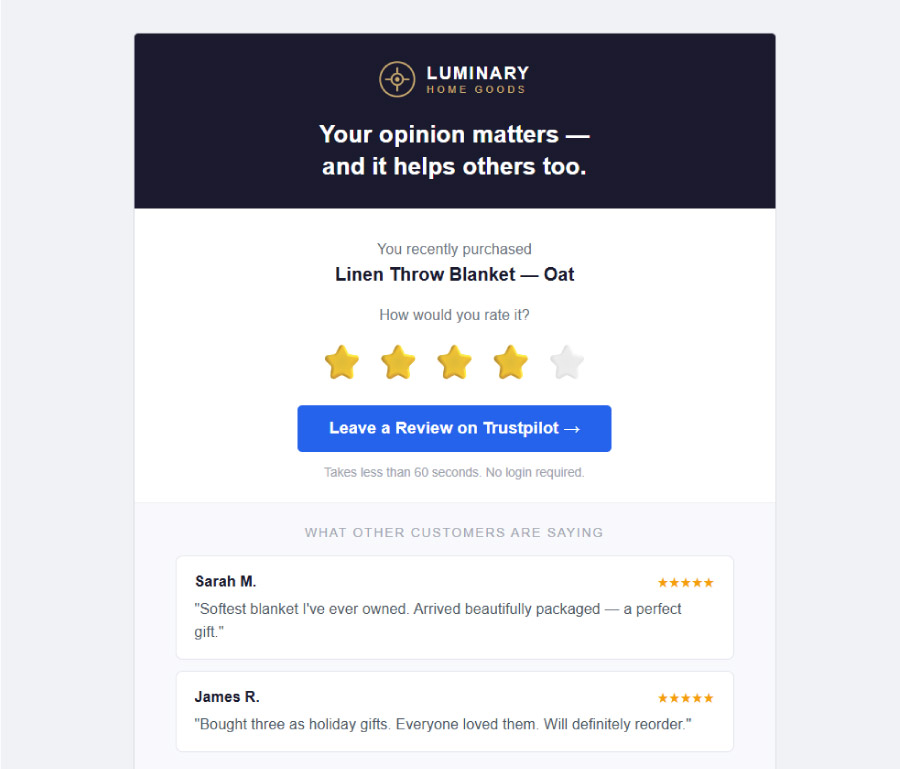
- Send a post-purchase review request: timing matters. Send the request 3-7 days after delivery, when the experience is fresh. Keep it short: one click to leave a star rating, with an option to write more.
- Make it easy: link directly to your Google Business profile, Trustpilot page, or product review section. Every extra step reduces the number of reviews you’ll get.
- Incentivize without bribing: offer a small discount on the next purchase as a thank-you for leaving a review. This is legal and effective. Avoid asking only for positive reviews, it violates most platform policies.
- Use reviews in your emails: once you have them, put them to work. Feature star ratings and customer quotes in your promotional emails, abandoned cart sequences, and welcome series. A single strong testimonial near your CTA can significantly increase conversions.
- Create a referral loop: invite your existing subscribers to share your brand with friends in exchange for a reward. Turn your happy customers into your most effective sales channel.
The more reviews you collect, the more trustworthy your brand appears to both new customers and search engines. Start asking. Most satisfied customers are happy to help, they just need to be asked.
11. Leave Your Readers in Suspense
The best email marketers don’t just think about the email they’re sending: they think about the next one. How you end a message determines whether your subscribers look forward to hearing from you again or quietly disengage.
The technique is simple: end every email with a hint of what’s coming next. Create anticipation. Make unsubscribing feel like missing out.
Here’s how to apply it across different businesses:
- 🎓 Online courses and education: “Next week we’ll show you the one technique that doubles retention. You won’t want to miss it”.
- 👗 E-commerce and fashion: “On Thursday we’re revealing our new autumn collection: subscribers get first access 24 hours before anyone else”.
- 🍕 Food and recipes: “Next week: the recipe our subscribers have been asking for all year. Stay tuned”.
- 💼 B2B and services: “In our next email, we’re sharing the exact framework we used to grow our client’s revenue by 40% in 90 days”.
- 📣Any business: “We’re about to announce something big. Keep an eye on your inbox”.
This technique works because of a well-documented psychological principle called the Zeigarnik effect: our brains remember unfinished things better than completed ones. An open loop in your email creates a mental itch that only your next message can scratch.
Used consistently, this approach transforms your email list from a passive audience into an engaged community that actively looks forward to your next message, and that kind of engagement is what drives long-term sales.
12. Create Appealing Welcome Emails
The welcome email is the most important email you’ll ever send. It arrives at the moment of maximum interest, right after someone has decided to trust you with their inbox. Open rates for welcome emails average 60-70%, compared to 20-25% for regular campaigns. That’s your best chance to make a lasting first impression.
A great welcome email does three things: it confirms the subscriber made the right choice, it sets expectations for what’s coming, and it gives them an immediate reason to engage.
Here’s what the perfect welcome email looks like:
- A warm, personal opening: address them by name and acknowledge that they’ve just joined something worthwhile. Avoid generic “Thank you for subscribing” openers, they waste the most valuable line in the email.
- Deliver on your promise immediately: if you offered a discount, a free guide, or exclusive content in exchange for signing up, deliver it in the welcome email. Don’t make them wait.
- Tell them what to expect: “Every Tuesday we’ll send you one actionable tip to grow your sales.” Specific promises build anticipation and reduce unsubscribes.
- Show your personality: the welcome email is where subscribers decide whether they actually want to hear from you. Be human, be genuine, and match the tone of your brand.
- Include one clear CTA: don’t overwhelm a new subscriber with options. One action: visit your best content, claim their discount, or follow you on social media.
- Consider a welcome series: a single email is good, a sequence of 3-5 emails spread over the first two weeks is better. Use it to introduce your brand story, showcase your best products, and build the relationship before you start selling.
With Emailchef Flow, you can set up an automated welcome series that triggers the moment someone subscribes. Each email goes out at exactly the right time, with exactly the right message.
Find out more about Emailchef Flow!

13. Use CTAs
It might seem obvious, but it can’t be overstated: your CTA is the single most important element in your email. Everything else (the subject line, the copy, the images) exists to get the reader to click that button. If your CTA fails, the whole email fails.
Here’s what makes a CTA work:
- Be specific, not generic: “Shop now” and “Click here” are weak. “Get my 20% discount”, “Download the free guide”, or “Start my free trial” tell the reader exactly what happens when they click, and what they get.
- Use first-person language: “Get my discount” consistently outperforms “Get your discount” in A/B tests. Small change, measurable difference.
- Make it visually impossible to miss: use a contrasting color that stands out from the rest of your email. Your CTA button should be the first thing the eye is drawn to after the headline.
- Place it above the fold: don’t make subscribers scroll to find it. Your primary CTA should be visible without scrolling on both desktop and mobile.
- Use one primary CTA: multiple CTAs compete for attention and reduce clicks. If you must include secondary links, make them visually subordinate to the main button.
- Create urgency when appropriate: “Get 20% off — today only” outperforms “Get 20% off” because it gives a reason to act now rather than later.
There are no universal rules for CTAs, what works for one audience may not work for another. That’s why A/B testing your CTA wording, color, size, and position is one of the highest-leverage tests you can run. Track the results, iterate, and let the data decide.
14. Use the word YOU
The best way to make a subscriber feel connected to your brand is to talk to them directly, not at them. The simplest way to do this is to use the word “you” throughout your emails. It shifts the tone from broadcast to conversation, and that shift changes everything.
Even better, use their name. Research published in the journal Brain Research shows that hearing or seeing our own name activates unique neural responses that other words don’t trigger. Our name is tied to our identity, so an email that uses it immediately feels more personal and relevant than one that doesn’t.
A few practical guidelines:
- Use “you” more than “we”: your email should be about the subscriber, not about your brand. Count the “you”s and “we”s in your next email. If “we” wins, rewrite it.
- Personalize the subject line: “Sarah, your exclusive offer is waiting” gets more opens than the same email without the name. Use Emailchef’s placeholder fields to insert each subscriber’s name automatically.
- Use the body copy: don’t limit personalization to the subject line. A single “Hi Sarah” at the start of the email sets a completely different tone.
- Be cautious with over-personalization: using someone’s name too many times, or referencing data they didn’t consciously share, can feel intrusive rather than personal. One or two mentions per email is enough.
15. Integrate Email and Social Media
Email and social media are stronger together than either is alone. The average person spends over 2 hours a day on social media, but email reaches them in a more focused, intentional moment. Used together, they reinforce each other and expand your reach in ways neither channel can achieve independently.
Here’s how to integrate the two effectively:
- Add social links to every email: make it easy for subscribers to find and follow you. Place social icons in your email footer as a minimum, or feature them more prominently in dedicated campaigns.
- Turn your subscribers into social followers: don’t just add icons. Give them a reason to follow: “Join our Instagram community for daily tips” or “Follow us on LinkedIn for behind-the-scenes content you won’t find anywhere else.”
- Use email to amplify social campaigns: launching a hashtag? Running a contest? Use your email list to kickstart it. Your subscribers are your most engaged audience, they’re the ones most likely to participate and spread the word.
- Repurpose user-generated content: if subscribers share photos of your products on Instagram or tag you in posts, feature that content in your emails. It’s free social proof that feels authentic.
- Use social media to grow your email list: run lead generation campaigns on Facebook or Instagram that drive people to sign up. Your social following is a pool of potential email subscribers.
- Track influencers in your field: monitor what content resonates with their audiences and use those insights to shape your email content strategy.
The goal is a seamless experience across channels. A subscriber who follows you on Instagram and reads your emails is far more likely to buy than someone who only knows you from one channel.
16. Use Abandoned Cart Emails
Every abandoned cart is a sale you almost made. The customer found your product, added it to their cart, and then left, often for reasons that have nothing to do with not wanting it. They got distracted, they wanted to think about it, or they were interrupted. A well-timed abandoned cart email brings them back.
The numbers make this one of the highest-ROI strategies in e-commerce email marketing: abandoned cart emails convert nearly 55% of subscribers into customers, 168% higher than the average marketing email. Sending a sequence of three emails generates 69% more orders than a single reminder.
Here’s how to build an effective abandoned cart sequence:
- Email 1 — within 1 hour: a simple, friendly reminder. Show the product they left behind with a clear image, the price, and a single CTA: “Complete your purchase.” No pressure, no discount, just a helpful nudge.
- Email 2 — after 24 hours: add social proof. Include a customer review of the product they were considering. Remind them what they stand to lose (limited stock, high demand, or a time-sensitive offer if applicable).
- Email 3 — after 72 hours: if they still haven’t purchased, this is the moment to offer an incentive. A 10-15% discount or free shipping is often enough to tip the decision. Create urgency: “Your cart is about to expire.”
💡A few additional tips
- 🛍️ Show the exact product: always display the specific item they abandoned, not a generic selection from your store.
- 🔄 Make it easy to return — one click should take them directly back to their cart, pre-filled and ready to complete.
- ✂️ Keep the copy short — abandoned cart emails work best when they’re simple and focused. This isn’t the place for long-form content.
With Emailchef Flow, you can automate the entire sequence: set it up once and it runs automatically every time a customer abandons a cart, at exactly the right intervals.
17. Stay Out of the Spam Folder
Your campaign won’t generate results if your emails never reach the inbox. Deliverability (the ability to land in the inbox rather than the spam folder) is one of the most underestimated factors in email marketing performance. You can have the best subject line and the most compelling offer in the world, but if Gmail sends your email to spam, none of it matters.
Here’s what affects your deliverability and what you can do about it:
- Build a clean list: only send to people who have explicitly opted in. Purchased lists and scraped emails are the fastest way to destroy your sender reputation.
- Remove inactive subscribers regularly: a list full of people who never open your emails signals to inbox providers that your content isn’t wanted. Clean your list every 6 months.
- Authenticate your domain: set up SPF, DKIM, and DMARC records for your sending domain. These technical standards tell inbox providers that your emails are legitimate. Most professional platforms guide you through this setup.
- Monitor your sender reputation: keep your spam complaint rate below 0.1% and your bounce rate below 2%. Both are tracked automatically by platforms like Emailchef.
- Avoid spam trigger words: phrases like “free money”, “act now”, “guaranteed”, and excessive use of capital letters or exclamation marks can trigger spam filters before a human ever sees your email.
- Warm up new sending domains: if you’re sending from a new domain, start with small volumes and gradually increase. Sending thousands of emails from a brand new domain is a red flag for inbox providers.
- Test before you send: use spam testing tools to check your email before sending to your full list. Emailchef includes built-in deliverability checks so you can identify and fix issues before they affect your campaign.
Choosing a professional email marketing platform is the single most important decision for your deliverability. Emailchef manages the technical infrastructure (dedicated IP addresses, authentication protocols, and real-time monitoring) so you can focus on creating great emails instead of worrying about whether they’ll arrive.
18. Don’t Give Up Your Email Marketing Strategies
Email marketing rewards consistency. The sellers who get the best results aren’t necessarily the ones with the biggest lists or the biggest budgets: they’re the ones who keep showing up, testing, and improving with every campaign they send.
If your first campaigns don’t perform as expected, don’t stop. Look at the data: was it the subject line, the offer, the timing, or the audience? Use A/B tests to isolate the variable, fix it, and try again. Every campaign that doesn’t work teaches you something that your next one can use.
A few things to keep in mind as you build your strategy:
- Results compound over time: a well-nurtured email list gets more valuable with every month. The work you do today pays dividends for years.
- Small improvements add up: raising your open rate by 2% and your click rate by 1% might seem modest, but across thousands of subscribers and dozens of campaigns, those numbers translate into significant revenue.
- The platform matters: the right tool makes the difference between email marketing that feels like a chore and email marketing that runs itself. Emailchef is built to make every step of this process simpler: from building your list to automating your sequences to tracking your results in real time.
Put these 18 strategies into practice and start turning your email list into your most profitable sales channel.
Frequently asked questions about email marketing strategies
The most impactful tips are: offer a compelling lead magnet to grow your list, write subject lines that create curiosity or urgency, personalize every message with the subscriber’s name and relevant content, automate key touchpoints like welcome emails and abandoned cart sequences, and A/B test continuously to improve results. Consistency matters more than perfection: the sellers who win with email marketing are the ones who keep testing and improving with every campaign.
Yes, email marketing is consistently the highest-ROI digital marketing channel, generating an average return of $42 for every $1 invested. Specific tactics like abandoned cart emails convert nearly 55% of subscribers into customers, while personalized subject lines increase open rates by up to 50%. For e-commerce companies and sellers, email marketing is one of the most direct and measurable ways to drive revenue.
Start by building a quality list of subscribers who have opted in to receive your communications. Then send targeted, personalized messages at the right time: welcome emails when they subscribe, promotional campaigns when you have an offer, and abandoned cart reminders when they leave without purchasing. Automate the key sequences so they run without manual work, and track open rates, click rates, and conversions to improve every campaign.
The fastest improvements come from A/B testing your subject lines, optimizing your CTAs, and segmenting your list so each group receives content relevant to them. Beyond that: clean your list regularly to remove inactive subscribers, authenticate your domain to improve deliverability, and make sure every email is optimized for mobile. Small, systematic improvements compound over time into significantly better results.
The highest-impact strategies for e-commerce are: abandoned cart email sequences (which convert nearly 55% of subscribers), post-purchase review requests, welcome series for new subscribers, and exclusive offers for your email list. Combine these with personalization and automation, and email becomes your most profitable sales channel, outperforming social media and paid advertising on ROI.